It never changes a grade.
A conversation is not a review. Your grades and due dates are the answer’s alone.
SPACED REPETITION, OUT LOUD
Loudwalk asks you today’s cards through your headphones and grades what you say back, in your own words. It starts from the file you export out of Anki: your decks, your media, every review you have ever done. And when a card leaves you with a question, you ask it out loud and get a real answer before carrying on.
Reviewing on screen is free, forever. No account, works offline. The voice tutor starts at €11.99/month after a 7-day trial. No card to start.

.apkg and .colpkg, review history includedHEAR IT
One card asked, an answer graded, a question asked back, and the walk carrying on. The transcript is all here if you cannot listen right now.
LOUDWALK
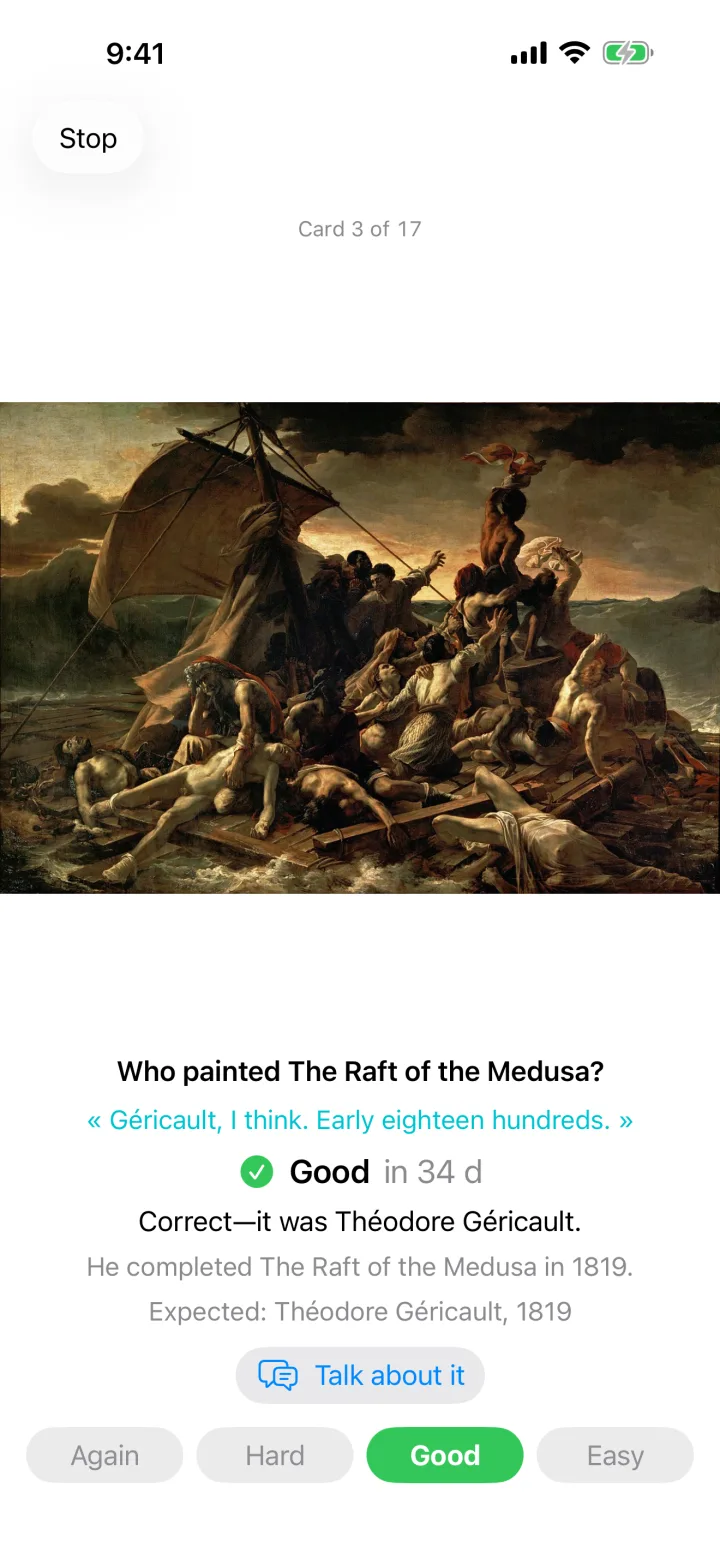
Who painted The Raft of the Medusa?
YOU
Géricault, I think. Early eighteen hundreds.
LOUDWALK
Correct: Théodore Géricault painted The Raft of the Medusa. He completed the painting in 1819, inspired by a notorious French shipwreck.
Graded correct
YOU
Why was it such a scandal at the time?
LOUDWALK
Let's dig in.
A question opens a conversation
LOUDWALK
It was a scandal because he put recent political failure on a heroic scale. The wreck had happened just a few years earlier, and the government tried to hush it up. He shows real human suffering, not myth or pretty history.
YOU
And where is it today, that painting
LOUDWALK
In the Louvre in Paris. It’s huge. You stand in front of it and it just overwhelms you.
Back to the cards
YOU
Next.
LOUDWALK
Back to the cards.
LOUDWALK
Who sculpted The Thinker?
THE LOOP
No buttons to press and nothing to look at. The whole review happens in your ears.
Your due card, phrased for speech and worded differently each time, so you learn the answer rather than the shape of the question.
Speech is recognised on your device. Say it your way: what is graded is the substance of the answer, against the answer written on your card.
The right answer, spoken, and a line of context when you got it right. Disagree? Override the grade. The schedule replays as if it had been right the first time.
Say “tell me more”, or just ask your question, and the card becomes a conversation with the teacher. Say “next” and you are back on the cards, where you left off.
NEW DEEP DIVE
A deep dive is a live, spoken conversation with the teacher about one card. She knows the card, whether it is new to you, and the wrong answers you have given it. You can cut in whenever you like.
Open one mid-walk by asking, or from any card on screen. When a precise fact matters, like a date or where a painting hangs today, she checks it on the web while she talks.
A deep dive is a live call: while it lasts, your voice and the card go to OpenAI through our server. We keep neither the audio nor the transcript. Your review answers are still transcribed on your device.
Guernica. That's Picasso in 1937. It's this huge, raw response to the bombing of a Basque town during the Spanish Civil War.
What about that hits you first, the sheer scale, the politics, or Picasso's style?
Wait — why is it all black and white?
That choice is chilling, right? He strips color out to evoke newsprint and to make it feel stark and mournful, almost like a documentary snapshot of horror. How does that absence of color change how you feel about it?
And where is it today? Has it always been there?
Good question. Um, the where is a little twisty…
Today it's at the Reina Sofía in Madrid, but it moved around a lot. It was shown in Paris in 1937, then later stayed at MoMA in New York, and it only returned to Spain in 1981 after democracy was restored.
Fact-checked mid-conversationGreat. That's all for me, thanks.
Okay, I'm glad we got to dig into it.
A second recording, on a card about Guernica, with the fact-check you can hear her run mid-sentence. Her replies are unscripted; the learner’s voice is synthesized.
A conversation is not a review. Your grades and due dates are the answer’s alone.
Each conversation is saved on your devices, and she picks up where you left off next time.
“Next” on a walk, goodbye, a press on your AirPods, or silence: twenty seconds mid-walk, a minute from a card on screen.
Walking includes 30 minutes a month, 5 in the trial. One conversation runs to 20 minutes from a card on screen and 5 mid-walk. Unlimited has no monthly conversation time allowance.
ON THE PHONE
The same cards, the same schedule, the same history, whichever way you reviewed them. A card needs a question and an answer in words to be asked out loud; the ones that are a picture or a sound stay on screen.
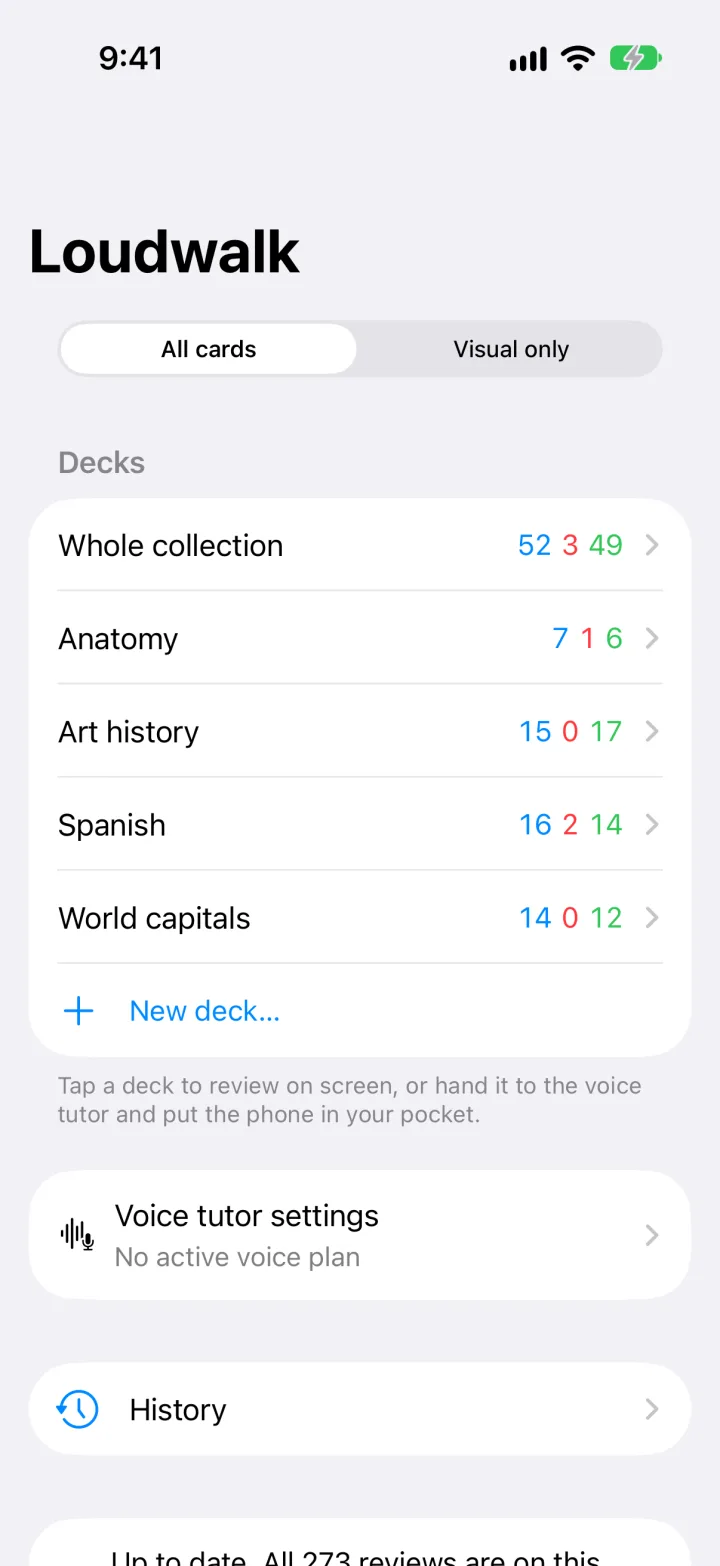
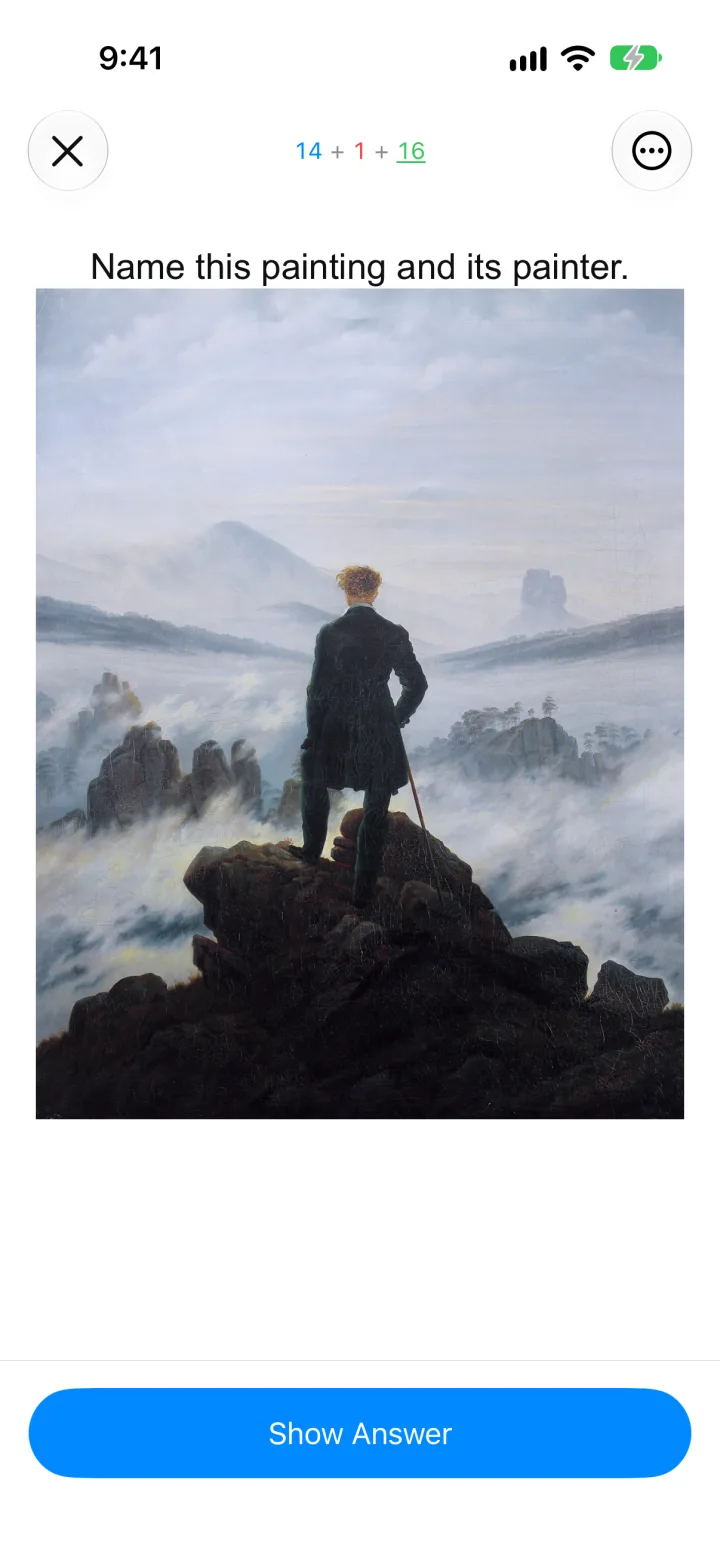
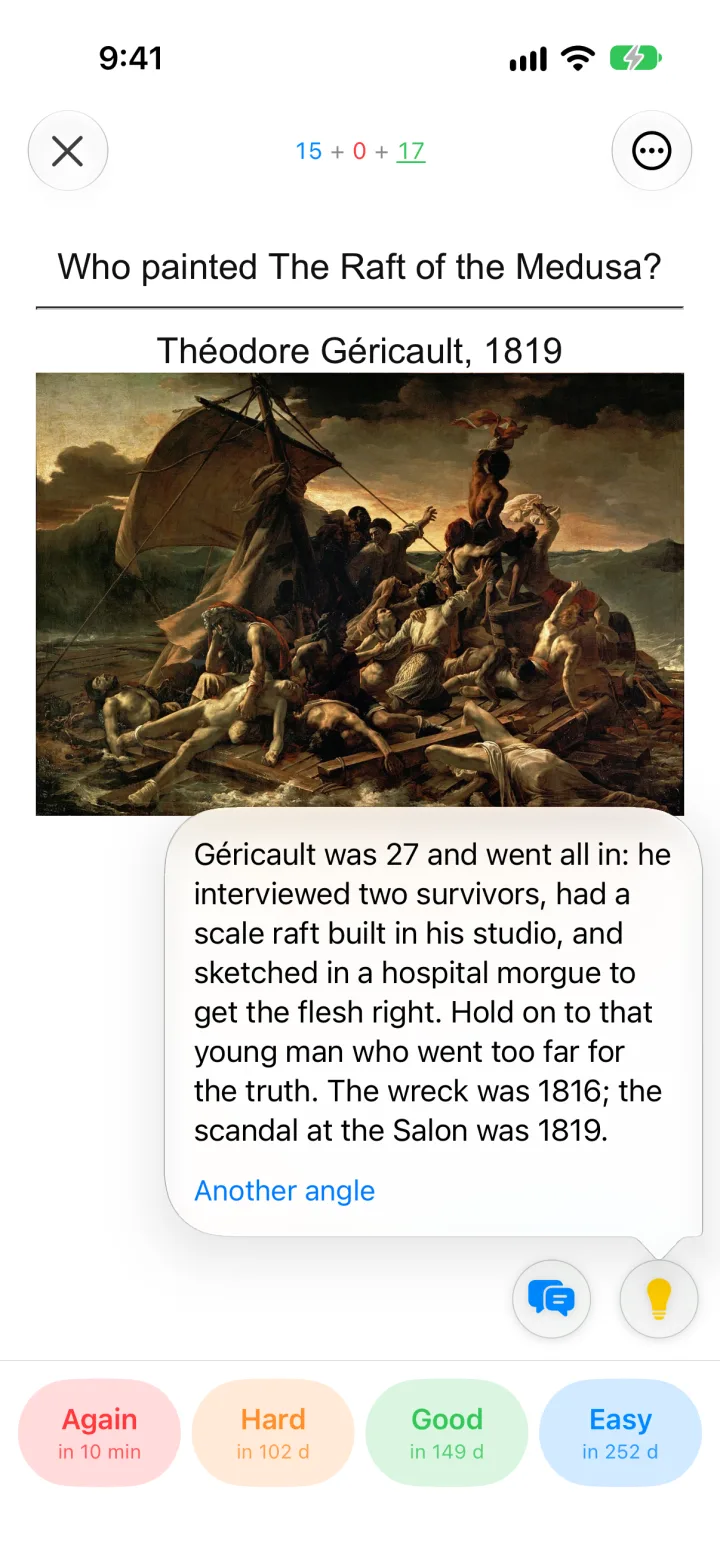
Captured from the iPhone build in Apple’s Simulator, on a sample collection. A simulator cannot hear, so the walk at the top of this page is staged there, with what the tutor really answered. The paintings are in the public domain.
TRY THE GRADER
Three sample cards, in your browser, with no account. It is the same idea as a walk: answer in your own words and the grade is about the substance. Your own decks, and the conversation, are in the app.
Live AI grading · Three cards · No sign-up
Speaking is optional. Your browser may send microphone audio to its speech provider. Your answer text goes to Loudwalk and OpenAI for grading. We don’t save your answer text. Temporary session, verdict, and network-hash records help prevent abuse. Read the details.
The native app uses Apple’s on-device speech recognition. This browser challenge uses fixed sample cards and a compact AI grader.
One question at a time.
Speak your answer, or type it.
No microphone access until you choose to speak.
YOUR COLLECTION
Loudwalk reads an Anki export: decks, notes, your notetypes with their own templates and CSS, media, and every review you have ever done. Due dates do not move, and your deck presets come across — FSRS parameters, desired retention, learning steps, daily limits.
Your Anki collection is read once and never written to; Loudwalk keeps its own schedule and history from there. If it is not for you, the Mac app hands it all back as one Anki file: your cards, every review you did here beside the ones you brought, and the schedule as it stands. Import it in Anki and carry on.
[sound:] audio..colpkg / .apkg that Anki imports.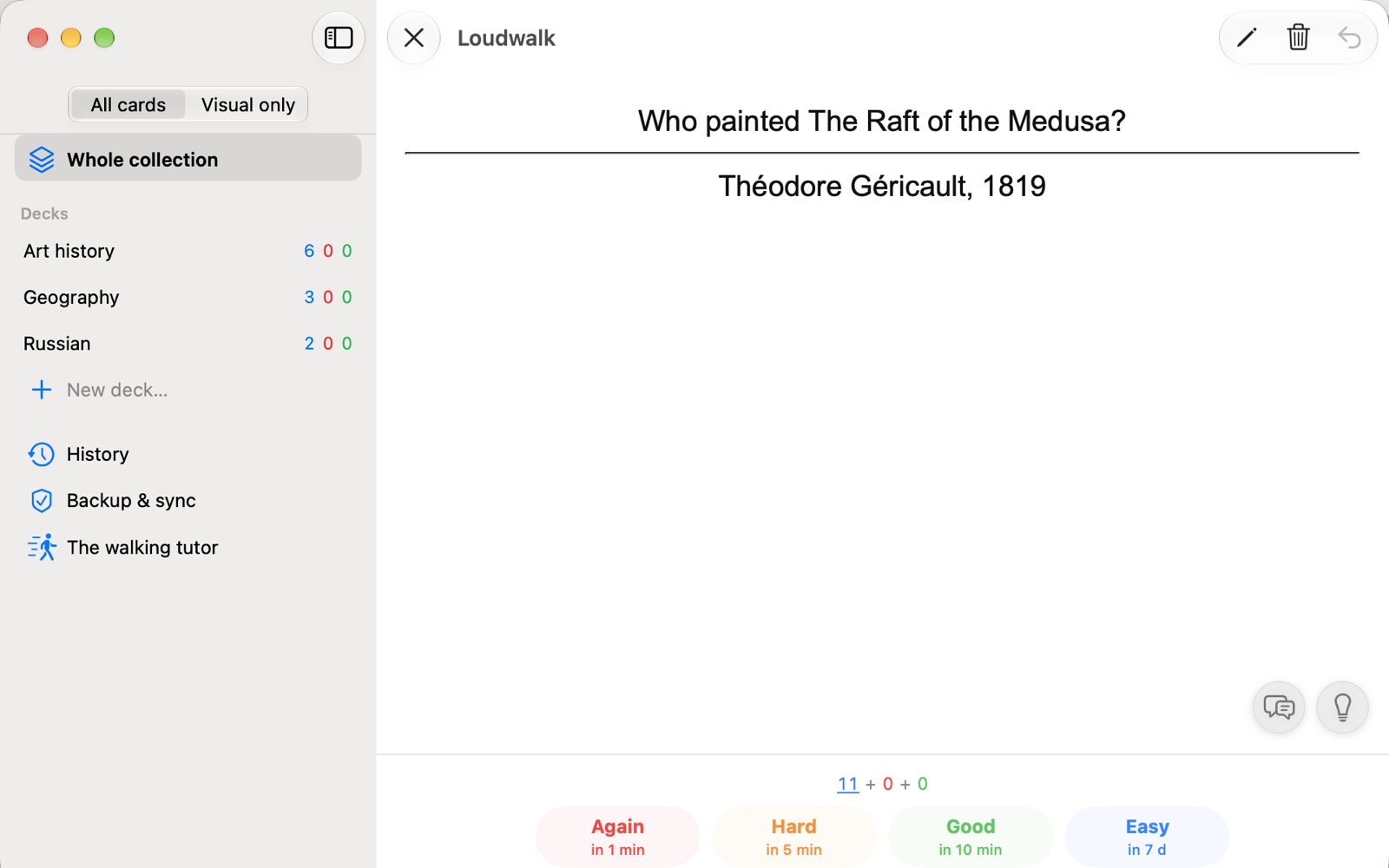
PRICING
The app, your collection and the schedule cost nothing and need no account. The subscription pays for what happens on a server: the voice, the grading and the conversations.
€0forever
On-screen review is free, forever.
Your cards and your history stay yours — and exportable — if you never subscribe, or when you stop.
€11.99/ month
Tax included. Cancel any time.
Already tried it? Your licence comes by email. You have 30 days to change your mind.
On iPhone you subscribe in the app, and Apple bills and manages it; on the Mac, here. Trial: 150 graded reviews, 60 a day, 5 minutes of deep dive. No payment card to start, no automatic charge. Past the monthly allowance the tutor stops for the month; on-screen review carries on.
$99USD / month
US App Store price; local prices vary. Cancel any time.
Subscribe in Voice tutor, then use “Connect your Mac” on iPhone to include your Mac. Apple manages billing.
For your own studying. No automated use or account sharing. Internet required. Inactive conversations close automatically. Subscribe in the iPhone app and connect your Mac to the same subscription. Live connections may need restarting after an hour; you can continue the same card.
UNDER THE HOOD
FSRS-6 inside Anki’s v3 scheduler: learning steps, fuzz, the load balancer, day boundaries and daily limits. It is held to answers recorded from a real Anki install (26.08.1): 750 answer transitions, 2,862 fuzz draws and 8 queue snapshots replay identically in the engine’s test suite, which has to pass before a release is built. You can read the fixture yourself: the recorded answers and the script that recorded them.
The memory model is a Swift port of py-fsrs 6.3.1 (MIT), held to golden cases generated from it. Anki’s rules around that model — the queue, day boundaries, fuzz and the load balancer — were written from observed behaviour and verified against the answers above, and Anki’s RNG comes from the MIT-licensed randcrates so that fuzz lands on the same day. No Anki code, and nothing under the AGPL.
Apple’s speech stack does that locally, so the recording of an answer never leaves. What leaves is the card’s text and your transcript, for grading. The exception is a deep dive, which is a live call and is labelled as one everywhere it appears.
Voice calls go through our service, which owns the prompt, the voice, the models and the allowance. That is also why the tutor is a subscription: it is a service, with a bill every month and a server that has to be up while you are already outside. The app on your machine is not part of that, so it is not part of the price.
Loudwalk.app/Contents/MacOS/Loudwalk cards add|edit|import — one JSON object per call, and a duplicate check on the question that is stricter than Anki’s (it ignores case and accents, and refuses rather than warns), so a retried batch adds nothing twice. Point Claude or Codex at a PDF and let it write the deck; the app picks the cards up on its next sync.
The model judges content only: it compares what you said with the answer on your card, and never invents the answer. Turning that verdict into Again, Hard, Good or Easy is plain code you can predict: a right answer stays Good however long you hesitated, up to 25 seconds; past that, or after you asked to hear the question again, it is capped at Hard. Easy needs an answer that is both instant and one the grader is sure of, which is why it is rare.
BEFORE YOU DOWNLOAD
Better here than in a review. Everything on this list is true today, 7 October 2026.
.colpkg replaces the collection there, exactly. An .apkg is merged, and Anki’s merge leaves cards it already has alone — so delete those decks in Anki first, or bring the whole collection.WHO MAKES THIS
I am Antoine. I built Loudwalk for my own collection: 8,403 cards and 113,012 reviews of history, mostly art history, Russian and English, imported from the Anki I had been using for years. I wanted those cards on my morning walk, and I wanted to be able to stop and ask why.
Everything on this page is in the app I use every day, on my Mac and on my iPhone. If something here turns out not to be true, write to me and I will fix the app or the page, whichever is wrong.
And if I stop: the app keeps working. Reviewing, scheduling, editing, sync and export never call a server, so nothing about them expires on its own, and there is no account to lose. The tutor is the part that depends on me. Your collection and your history are files in your own iCloud Drive, in formats you can read — and the app writes them back out as an Anki file, so leaving costs you one import.
QUESTIONS
No, and I am not planning to open the app: it is the thing I would sell if this ever became a living, and I would rather say so plainly. What I can publish, and have, is the evidence that the scheduling matches Anki: the recorded answers and the script that recorded them.
It contains no Anki code: no AGPL, no fork, no add-on. It reads the SQLite file an Anki export contains; the memory model is a Swift port of the MIT-licensed py-fsrs, and Anki’s rules around it were written from observed behaviour and verified against those answers. Loudwalk is not affiliated with or endorsed by Ankitects.
The app is not the subscription. Importing, reviewing on screen, the scheduler, the editor, sync and export are free, offline and account-free, and stay that way. The subscription buys inference: a voice speaking your cards, a model reading your spoken answer, and a live conversation that costs money for every minute it is open. If you stop paying you keep the app, your cards and your history.
Because the part that costs money here runs every time you speak, not once when you install. The part that compares with AnkiMobile — reviewing your collection on your own devices — is the free half of Loudwalk. The monthly price is for the tutor.
Yes, including back into Anki. On the Mac, Backup & sync → Going back to Anki writes a .colpkg or an .apkg: your cards, every review you did here beside the ones you brought, and each card’s due date, interval and FSRS memory state as they stand. It is a copy of the file you imported with Loudwalk’s work laid over it, so tags, flags and deck presets come back as they left, and a card you never answered here comes back byte for byte. I hold it to Anki itself: this script has the Anki on my Mac build a collection, runs it through Loudwalk, imports the result and reads every card back — deck, due date, memory state, review rows, and Anki’s own Check Database. Beyond that, your reviews are an append-only JSONL log in your own iCloud Drive, alongside 30 daily snapshots, the app also exports to JSON and CSV, and your media stays as ordinary files on disk.
During a spoken review: the card’s text and the transcript your device produced, for grading and for the teacher’s reply. Never the audio. During a deep dive: the live audio itself, to OpenAI through our service, for as long as the conversation lasts. Nothing else — your collection, your history and your media stay on your devices and in your own iCloud.
Yes, on iPhone: start with Siri, keep walking with the phone locked, stop with a press on your AirPods. On a Mac, a walk is a desk session with headphones.
Nothing is charged: the trial takes no payment card. On-screen review carries on free. To keep the tutor, subscribe for €11.99 a month.
Free to review on screen · 7-day tutor trial, no card · iPhone and Mac